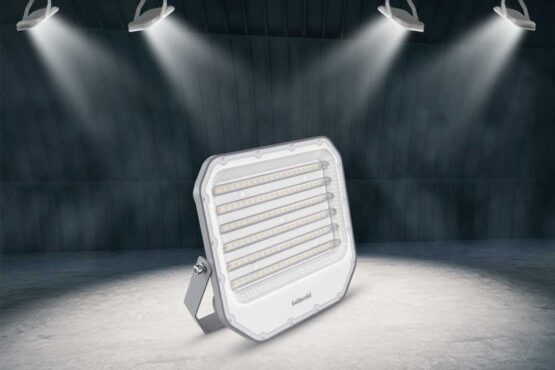
When shopping for lighting products, most people focus on wattage, brightness, or energy consumption. While these factors are important, there is another feature that often goes unnoticed but can significantly affect lighting performance: beam angle.
Beam angle refers to the width of light emitted from a fixture. In simple terms, it determines how widely or narrowly the light is distributed across a space. Two floodlights may have the same wattage and lumen output, yet produce very different lighting results because of their beam angles.
A narrow beam angle concentrates light into a smaller area. This creates a brighter and more focused effect, making it suitable for highlighting specific objects, building features, signboards, or security-sensitive locations. Because the light is concentrated, it appears more intense within its coverage area.
A wider beam angle spreads light across a larger surface. While the light may appear less intense in any single spot, it provides broader coverage and more uniform illumination. This makes it ideal for parking lots, compounds, warehouses, sports facilities, and other large outdoor areas where consistent lighting is needed.
Choosing the wrong beam angle can lead to poor lighting performance even when the fixture itself is of high quality. A floodlight with a narrow beam angle installed in a large open compound may leave dark spots around the edges. On the other hand, a wide beam angle used for focused security lighting may not provide the intensity required for clear visibility.
This is why professional lighting design considers more than just wattage. The placement of fixtures, mounting height, and beam angle all work together to achieve the desired lighting effect.
At Energymall, we understand that every lighting application is different. Whether you need focused lighting for security purposes or wide-area illumination for commercial and residential spaces, selecting the correct beam angle can help you maximize performance while avoiding unnecessary costs.
The next time you compare lighting products, remember that brightness is only part of the equation. Understanding beam angle can help you achieve better visibility, improved efficiency, and a more effective lighting setup. Sometimes, the difference between excellent lighting and average lighting is not the wattage—it is how the light is distributed.