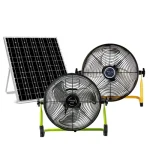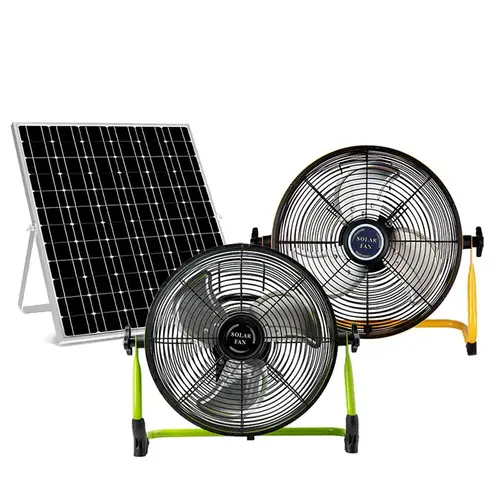
Understanding how much power a solar fan uses is important when choosing a fan, sizing its battery, or determining how long it can operate.
Unlike conventional appliances that are usually connected directly to the electricity grid, solar fans often work with solar panels and batteries, making energy calculations especially useful.
The amount of electricity a solar fan consumes depends on several factors, including its wattage, speed setting, operating hours, battery efficiency, and design.
What Determines Solar Fan Power Consumption?
The most important specification is the fan’s wattage.
Wattage tells you how much electrical power the fan uses while operating.
For example, a fan rated at 20 watts consumes approximately 20 watts of electrical power while operating at its rated condition. If it runs for five hours, its theoretical energy consumption is:
20W × 5 hours = 100Wh
This is known as watt-hours.
Understanding Watts and Watt-Hours
Watts and watt-hours are related but different.
- Watts (W) measure power.
- Watt-hours (Wh) measure energy consumed over time.
If a 20W fan operates for 10 hours:
20W × 10 hours = 200Wh
Therefore, the fan would require approximately 200Wh of energy under ideal conditions.
Actual battery requirements can be higher because batteries, charge controllers, and other components have efficiency losses.
How Battery Voltage and Capacity Affect Runtime
Battery capacity is commonly expressed in amp-hours (Ah).
To estimate the nominal energy stored in a battery, use:
Voltage × Amp-hours = Watt-hours
For example, a 12V 20Ah battery provides approximately:
12V × 20Ah = 240Wh
If a 20W fan were the only load, the theoretical runtime would be:
240Wh ÷ 20W = 12 hours
However, actual runtime will usually be lower because of battery efficiency, depth of discharge, wiring losses, and the fan’s actual power consumption.
Does Fan Speed Affect Energy Consumption?
Yes.
A fan operating at maximum speed may consume more power than the same fan operating at a lower speed.
For example, if a fan consumes 15W at low speed and 25W at high speed, running it continuously at high speed will drain the battery faster.
This is why fans with multiple speed settings can provide flexibility.
How Much Solar Power Is Needed?
The solar panel must be capable of generating enough energy to recharge the battery and support the fan’s usage.
Solar panel output varies depending on sunlight intensity, panel orientation, shading, temperature, and other environmental conditions.
A panel’s rated wattage is therefore not necessarily the exact amount of power it will produce throughout the day.
Example of Solar Fan Energy Calculation
Suppose a solar fan consumes 25W and you want to operate it for eight hours daily.
Energy requirement:
25W × 8 hours = 200Wh per day
If the system experiences losses, you may need more than 200Wh of solar generation to reliably meet that requirement.
This illustrates why choosing a solar fan should involve more than looking at fan size.
Why Battery Capacity Matters
If you intend to use the fan at night, the battery becomes especially important.
During the day, the solar panel can generate energy and charge the battery. At night, the battery supplies energy to the fan.
A larger battery can provide longer runtime, but a larger battery also requires an appropriately sized charging system.
What About Cloudy Weather?
Solar panels can still produce electricity when the sky is cloudy, but their output may be reduced compared with strong direct sunlight.
If you live in an area where cloudy weather is common during certain seasons, having adequate battery storage can help maintain operation.
How Can You Reduce Solar Fan Energy Consumption?
There are several ways to extend runtime:
1. Use an Appropriate Speed
Run the fan at the lowest comfortable speed rather than maximum speed all the time.
2. Keep the Solar Panel Clean
Dust and dirt can reduce the amount of sunlight reaching the solar cells.
3. Position the Panel Correctly
Place the panel where it receives adequate sunlight and avoid unnecessary shading.
4. Maintain the Battery
Follow the manufacturer’s charging and maintenance instructions.
Why Power Consumption Matters When Buying a Solar Fan
Knowing the fan’s power consumption helps you determine whether its battery and solar panel are appropriately sized.
A fan that consumes less energy may run longer from the same battery than a higher-powered model.
However, lower wattage does not automatically mean better performance. Airflow and cooling performance also matter.